If you have been trying to automate your Instagram business account, you have probably come across two very different types of tools described with similar-sounding names. One is called a chatbot. The other is called an AI agent. Many business owners use these terms interchangeably, but they are not the same thing at all. The difference between them determines whether your customers get useful, natural answers that move them toward buying, or whether they hit a wall of preset menus and give up.
In 2026 this distinction matters more than ever, because Instagram has become one of the primary places where buying decisions are made. The question of Instagram AI agent vs traditional chatbot is not a technical debate. It is a business decision with a direct effect on how many leads you convert, how professional your brand looks, and how much of your own time you get back.
This article explains how each type of tool works, where each one succeeds, where each one fails, and which one makes sense for the kind of business you are running.
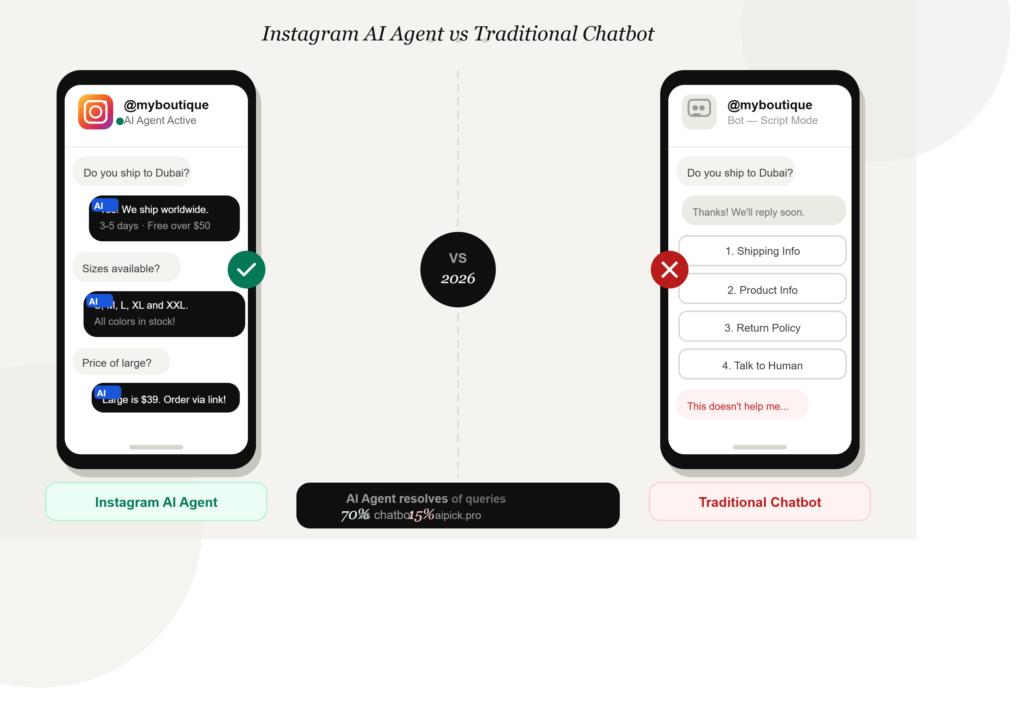
What a Traditional Chatbot Actually Is?
A traditional chatbot is built around a fixed set of rules. When a customer sends a message on Instagram, the chatbot scans the text for specific keywords or trigger phrases. If it finds a match, it sends back the pre-written response attached to that keyword. If it does not find a match, it either sends a generic fallback message or presents a menu of button options for the user to choose from.
This is sometimes called a flow-based system. The designer of the chatbot builds a conversation map in advance, deciding every possible path a conversation might take. The customer presses a button, the bot moves to the next node, the customer presses another button, and so on. At no point does the bot understand what the customer actually meant. It only recognises patterns and follows the script it was given.
Traditional chatbots were genuinely useful when they were introduced. For simple, predictable tasks like sending a PDF when someone comments a specific word, or showing business hours, they work reliably. The problem is that real customer conversations on Instagram are almost never simple or predictable. People ask questions in their own words. They mix two questions into one message. They use slang, abbreviations, or ask follow-up questions that fall outside the scripted paths. When that happens, a traditional chatbot either sends an irrelevant response or breaks down entirely.
What an Instagram AI Agent Actually Is?
An Instagram AI agent is fundamentally different in architecture. Instead of following a script, it uses a large language model to understand the actual meaning of what the customer typed. It reads the full message in context, considers what has been said earlier in the conversation, applies the business information you provided, and generates a relevant, natural-sounding reply. Explore More Details of Instagram AI Agent.
The key word here is understanding. A traditional chatbot matches words. An AI agent comprehends sentences. When a customer asks your Instagram account something the developer of a traditional chatbot never thought to write a script for, the AI agent handles it anyway, because it reasons from your business details rather than from a predefined decision tree.
This is why the experience of talking to a well-configured AI agent feels completely different from talking to a traditional chatbot. The customer gets answers that directly address what they asked, written in natural language, without any buttons to press or menus to navigate. Industry data from 2026 shows that AI-powered Instagram conversations involving more than ten messages achieve a qualification rate of nearly thirty percent, while short scripted replies achieve almost nothing. The architecture drives the outcome. Read more about Ready to Use Instagram AI Agent for Business in 2026 .
The Real-World Differences That Affect Your Business
The gap between the two technologies shows up immediately in the situations your customers actually create.
Consider a customer who sends this message to your Instagram clothing business: “Hi, do you have that dress in blue, and if so does it run small? Also what is your return policy if it does not fit?”
A traditional chatbot sees the word “dress” or “return” and fires the matching script. The customer gets a generic reply about the dress category or a copy-pasted return policy paragraph, with no acknowledgement that they asked about sizing, colour availability, or the specific combination of concerns they raised. The conversation dies there.
An Instagram AI agent reads the entire message and understands that three separate questions are being asked at once. It checks the business details you entered and responds with specific information about the color, a note about how the sizing runs, and a brief explanation of the return policy, all in a single natural reply. The customer feels heard. The conversation continues. The sale moves forward.
This is not a hypothetical difference. Research published in 2026 found that traditional chatbots successfully resolve only around fifteen percent of customer queries on their own. AI agents handle approximately seventy percent. For a business receiving five hundred messages per month, that gap represents hundreds of conversations that either convert or walk away depending entirely on which type of tool is handling the replies. Read more about Instagram Ai agent for customer support .
Where Traditional Chatbots Still Make Sense?
Being honest about this matters. Traditional chatbots are not obsolete in every situation. There are specific use cases where their predictability is actually an advantage.
If your automation need is extremely simple and completely repeatable, a traditional chatbot handles it cleanly. Sending a freebie download link when someone comments a specific word on a post, confirming a booking after a customer types their name and phone number into a structured sequence, or sending a standard welcome message to every new follower are all tasks where the rigid nature of a flow-based chatbot is acceptable because nothing unexpected needs to happen.
The failure point of traditional chatbots arrives the moment a customer deviates from the script. In a clothing store, a freelance service, a restaurant, a coaching business, or any operation where customers ask questions in their own words, traditional chatbots create friction rather than removing it. The customer experience deteriorates, the conversion rate drops, and the automation that was supposed to help the business ends up damaging its reputation instead.
What Each Type of Tool Costs You in Practice?
The financial comparison between Instagram AI agent vs traditional chatbot is not as simple as comparing monthly subscription prices.
A traditional chatbot might appear cheaper at first glance. Many flow-based tools offer free or low-cost starter plans. But the real cost is in what the tool fails to do. Every unanswered question, every customer who hits a menu that does not cover their situation, every lead who goes silent because the bot sent an irrelevant response is revenue that did not convert. Those lost conversations have a value. Most businesses that run the full calculation find that a cheaper chatbot that converts poorly is far more expensive over time than an AI agent that converts well.
An AI agent requires an upfront decision and a clear explanation of your business so it knows how to respond. Once that is done, it runs without ongoing manual input. You do not need to update scripts every time your product range changes, build new conversation flows for new questions, or hire someone to maintain the decision tree. You update your business description and the agent adapts. This maintenance difference alone saves significant time for any business operating at scale.
The Setup Experience Is Completely Different?
Setting up a traditional chatbot requires designing every conversation path in advance. You need to anticipate what questions customers will ask, write responses to each one, build the decision tree that connects them, test every branch to make sure it leads somewhere useful, and then rebuild sections every time your business changes. This is genuinely time-consuming work that most small business owners do not have the skills or the hours to maintain properly.
Setting up an Instagram AI agent is much simpler. You connect your Instagram business account through an official authorisation process. You write a description of your business in plain language, the same way you would explain it to a new employee on their first day. You save that description and the agent is live. No flow-building, no scripting, no decision trees. The intelligence lives in the model. Your input guides how that intelligence is applied to your specific business.
At Aipick.pro, the Instagram agent is ready to download and connect in under ten minutes. There is no technical knowledge required, no monthly subscription that auto-charges your account, and no lock-in. You pay manually through a crypto QR code and the agent activates immediately. If you want to understand the complete setup process before purchasing, the how-to-use guide on the site walks through every step from payment to first automated reply.
Which One Should You Choose between Instagram AI Agent vs Traditional Chatbot?
The answer depends on what you are actually trying to achieve on Instagram.
If your automation goal is a single, simple, repeatable task where every customer follows an identical path and asks an identical question, a traditional chatbot handles it adequately and costs less to start.
If your goal is to have genuine conversations with potential customers, answer the wide variety of questions that real people ask, qualify leads, describe your products or services accurately, and represent your business professionally at every hour of the day, then an Instagram AI agent is the only tool that achieves this. A traditional chatbot cannot hold a real conversation. It can only simulate one for as long as the customer asks exactly what the script expects.
For the vast majority of businesses using Instagram as a sales and customer service channel, the right choice in 2026 is an AI agent. The technology has become accessible, the setup is straightforward, and the difference in results between a scripted bot that frustrates customers and an AI agent that actually helps them is the difference between automation that works and automation that damages your brand.
The businesses that switched to AI agents earlier are already seeing better response rates, more conversions from DMs, and significantly less time spent manually replying to questions. The ones still running traditional chatbots are watching leads drop off mid-conversation and wondering why the automation is not delivering results.
Conclusion
The Instagram AI agent vs traditional chatbot question has a clear answer for most businesses in 2026. If you need genuine, intelligent conversation that converts interest into sales, an AI agent is the tool that delivers it. If your needs are limited to the most basic keyword-triggered responses, a traditional chatbot suffices. For everything else, the gap between the two is simply too large to ignore.
if you want to make your own ai agent you can use n8n.io website .
Thank You – Aipick.pro