Businesses lose a surprising amount of time answering the same WhatsApp messages: “Are you available tomorrow?”, “What time slots do you have?”, “Can I change my appointment?”, and the timeless classic, “Hello?” followed by absolute silence.
A WhatsApp AI Appointment Booking Agent can automate much of this process by communicating with customers through WhatsApp, collecting appointment details, checking available options, confirming bookings, and handling common scheduling requests.
For businesses that already receive a large number of customer inquiries through WhatsApp, appointment automation can reduce repetitive work while giving customers a faster way to schedule services.
This article explains what a WhatsApp AI Appointment Booking Agent is, how it works, which businesses can use one, what tasks it can automate, and what to consider before choosing a pre-built agent. Read more About Pre built Whatsapp AI Agent.
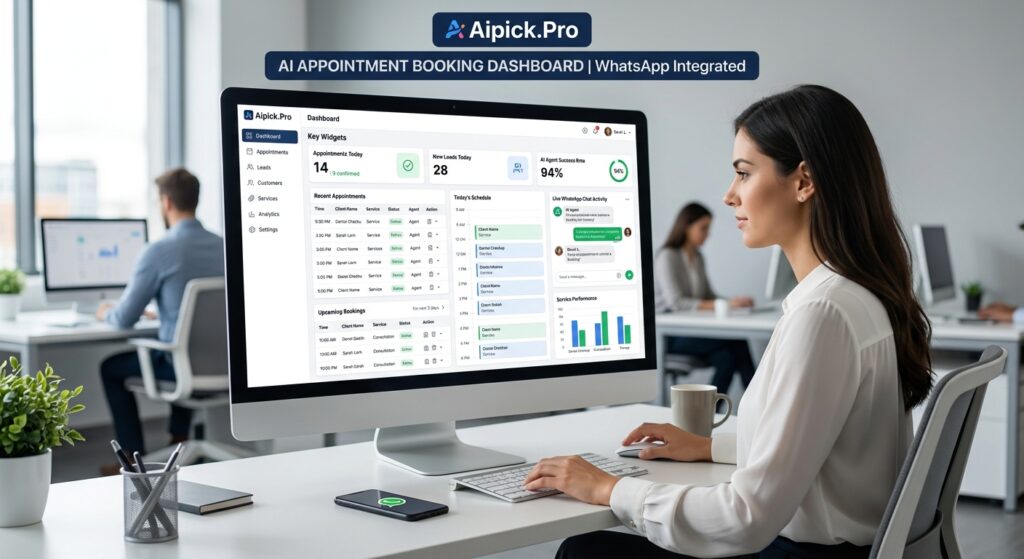
What Is a WhatsApp AI Appointment Booking Agent?
A WhatsApp AI Appointment Booking Agent is an AI-powered system designed to handle appointment-related conversations through WhatsApp.
Instead of requiring a customer to call a business or wait for an employee to respond manually, the AI agent can communicate with the customer, understand what they want, collect relevant information, and guide them through the booking process.
For example, a customer might send:
“I want to book a consultation for Monday.”
The agent can respond by asking for the required information, such as the preferred time, service type, or customer details. Depending on its integrations and configuration, it can then check available appointment slots and help complete the booking.
The important difference between a basic chatbot and an AI agent is that an agent can be designed around a task or goal, rather than simply displaying a list of predefined answers.
How Does a WhatsApp AI Appointment Booking Agent Work?
The exact architecture depends on the platform and integrations, but the general workflow looks like this:
Customer sends WhatsApp message → AI understands request → Agent collects information → Availability is checked → Appointment is booked → Customer receives confirmation
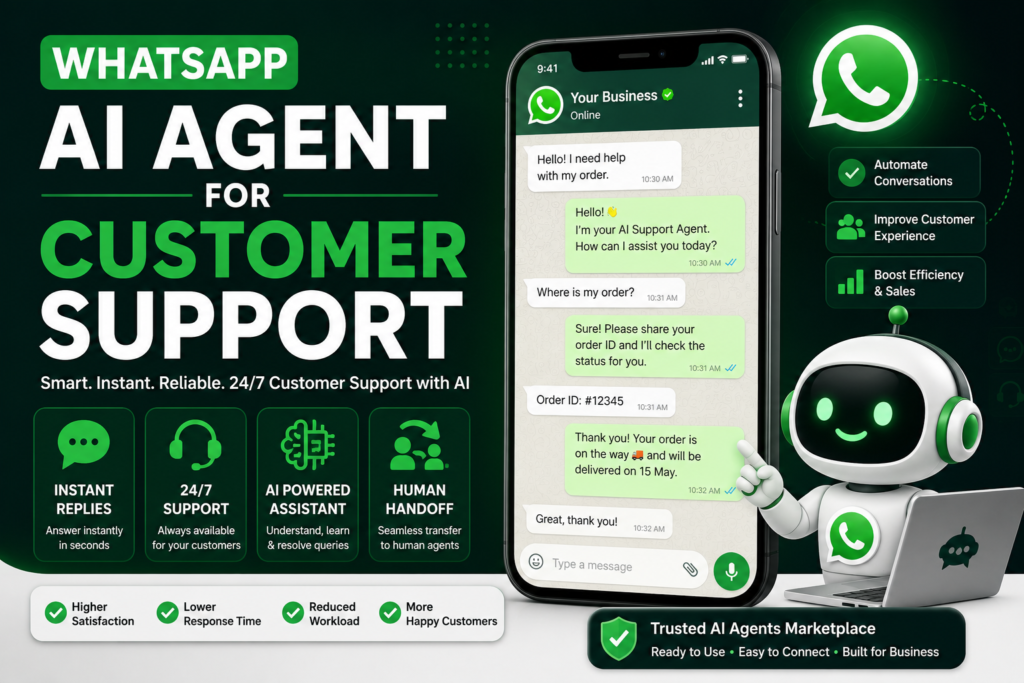
For example:
- A customer asks for an appointment.
- The agent identifies the requested service.
- It asks for the preferred date.
- It asks for a suitable time or presents available options.
- The customer selects a slot.
- The system records the appointment.
- The customer receives confirmation.
The agent can also be configured to handle related conversations, such as rescheduling or cancellation requests.
This makes appointment automation more useful than a simple contact form because the customer can complete much of the process directly inside a familiar messaging environment.
What Can a WhatsApp AI Appointment Booking Agent Automate?
The exact capabilities depend on the agent, but a well-configured system can automate several common scheduling tasks.
Appointment Requests
Customers can start a conversation whenever they want to schedule a service.
The AI can identify the purpose of the request and collect the information required to continue.
For example:
- Service required
- Preferred date
- Preferred time
- Customer name
- Contact information
- Additional requirements
This eliminates the need for employees to manually ask the same questions repeatedly.
Availability Questions
Customers frequently ask whether a business has an available slot.
Instead of requiring staff to check a calendar manually, an integrated agent can potentially retrieve available scheduling information and present suitable options.
For example:
“We have appointments available at 10:00 AM, 1:00 PM, and 4:00 PM. Which would you prefer?”
The exact capability depends on the calendar or booking system connected to the agent.
Appointment Confirmation
After a booking has been completed, the agent can provide confirmation details.
A confirmation might include:
- Customer name
- Service
- Date
- Time
- Location
- Appointment reference
- Instructions
This gives customers a clear record of what they booked.
Rescheduling
Customers often need to change their appointment.
Instead of requiring them to call the business, the AI can ask for the existing appointment information and guide them through selecting another available time.
This can be particularly useful for businesses with frequent appointment changes.
Cancellation Requests
A customer may need to cancel an appointment.
An AI agent can be configured to collect the appointment details and follow the business’s cancellation rules.
If the request falls outside the automated workflow, it can transfer the conversation to a human employee.
Which Businesses Can Use a WhatsApp AI Appointment Booking Agent?
Appointment automation isn’t limited to one industry. Any business that regularly schedules customers can potentially benefit.
Clinics and Healthcare Practices
Clinics receive large numbers of appointment-related questions.
An AI agent can assist with:
- Appointment requests
- Available times
- Rescheduling
- Cancellation requests
- Basic appointment information
Healthcare businesses should be especially careful about privacy, data handling, and what information the AI is permitted to process. An appointment assistant should not casually wander into giving medical advice just because humans have decided every software product needs to be a doctor now.
Salons and Beauty Businesses
Salons are particularly suitable for appointment automation.
Customers may want to book:
- Haircuts
- Hair coloring
- Makeup
- Facials
- Manicures
- Other services
The agent can ask which service the customer wants and guide them toward available appointment slots.
Consultants
Consultants often schedule introductory calls or paid consultations.
A WhatsApp-based booking agent can collect information about the customer’s request and help schedule an available time.
Tutors and Training Businesses
Educational businesses can use appointment automation for:
- Trial classes
- Consultation calls
- Student meetings
- Course consultations
- Private lessons
The agent can collect basic details before booking the session.
Repair and Home Services
Plumbers, electricians, technicians, cleaning companies, and other service providers can use appointment automation to arrange visits.
The agent can collect information such as the service type, preferred date, location, and basic description of the problem before scheduling.
Why Use WhatsApp for Appointment Booking?
WhatsApp is already used for everyday communication by businesses and customers in many markets.
That makes it a convenient environment for appointment conversations.
A customer doesn’t necessarily need to learn a new booking application. Instead, the booking process can happen through a messaging conversation.
This can be particularly useful when customers already contact a business through WhatsApp for questions, prices, availability, and service information.
The goal isn’t simply to add AI because AI is fashionable. The goal is to reduce friction in a process customers already perform through messaging.
Can a WhatsApp AI Appointment Booking Agent Work 24/7?
An AI agent can be designed to respond outside normal business hours, assuming the underlying WhatsApp setup and services support the required automation.
This means customers can potentially start appointment conversations at night, during weekends, or when employees are unavailable.
However, 24/7 availability does not mean every request should be automatically completed.
Some situations may require human assistance.
For example:
- Complex customer requests
- Special scheduling requirements
- Refund disputes
- Sensitive information
- Unusual appointment types
- Technical problems
- Requests outside company policies
A good automation system should know when to stop pretending it is omnipotent and transfer the conversation to a human.
WhatsApp AI Appointment Booking Agent vs Traditional Booking Forms
Traditional booking forms still have advantages. They are familiar, straightforward, and often easy to integrate.
However, they require customers to navigate a structured interface.
A conversational booking system works differently.
Traditional booking form
Customer:
Select service → Select date → Select time → Enter information → Submit
AI appointment agent
Customer:
“I need a haircut tomorrow afternoon.”
The agent can ask follow-up questions and guide the customer through the necessary steps.
The conversational approach can be useful when customers have questions before booking or when the appointment process requires several pieces of information.
Can the Agent Send Appointment Reminders?
Potentially, yes, depending on the WhatsApp integration and automation setup.
Reminder workflows can be designed around upcoming appointments.
For example:
24 hours before: appointment reminder
A few hours before: final reminder
The exact timing and messaging should be configured according to the business’s requirements and the applicable WhatsApp messaging rules.
Reminders can help reduce missed appointments, although businesses should not assume that automation completely eliminates no-shows.
Can Customers Talk to a Human?
A good WhatsApp AI Appointment Booking Agent should support human handoff when automation is no longer appropriate.
For example, the AI could handle:
“I want to book an appointment.”
But if the customer asks:
“I have a special situation. Can someone from the clinic speak with me?”
the conversation can be transferred to a human.
Human handoff is important because automation should support employees rather than create a digital maze that traps customers inside a conversation with a machine.
What Information Does the Agent Need?
Before deploying an appointment agent, the business needs to provide accurate information.
This may include:
- Business hours
- Services
- Service duration
- Available appointment times
- Staff availability
- Booking rules
- Cancellation policy
- Rescheduling policy
- Location
- Contact information
- Frequently asked questions
If the agent is connected to a calendar or booking system, it may also need the appropriate integration and permissions.
The quality of the automation depends heavily on the quality of the information and workflows behind it.
What Should You Check Before Choosing a Pre-Built Agent?
If you’re considering a pre-built WhatsApp AI agent, don’t choose one simply because the product page contains the words “AI automation” seventeen times.
Check the actual capabilities.
1. WhatsApp compatibility
Verify how the agent connects with WhatsApp and what setup is required.
2. Calendar integration
If the agent is supposed to schedule appointments, determine which calendar or booking systems it supports.
3. Human handoff
Make sure conversations can be transferred when the AI cannot appropriately handle a request.
4. Customization
Check whether you can customize services, business hours, policies, questions, and responses.
5. Appointment workflows
Look for support for booking, rescheduling, cancellation, and confirmation.
6. Data handling
Understand what customer information is stored, where it is processed, and how access is controlled.
7. Reporting
Useful analytics can show appointment requests, completed bookings, cancellations, and other relevant metrics.
Pre-Built vs Custom WhatsApp Appointment Agent
Businesses have two broad options.
A custom AI agent can be developed specifically for a company’s requirements. This can provide greater flexibility but generally requires more development work, configuration, testing, and maintenance.
A pre-built WhatsApp AI Appointment Booking Agent is designed around a common use case and can be configured rather than developed completely from scratch.
For a small business that primarily needs appointment scheduling, a pre-built agent can be a practical starting point.
The right choice depends on the complexity of the workflow, integrations, customization requirements, budget, and expected volume.
Frequently Asked Questions
What is a WhatsApp AI Appointment Booking Agent?
It is an AI-powered system that communicates with customers through WhatsApp and can automate appointment-related tasks such as collecting booking information, presenting available options, confirming appointments, and handling certain rescheduling or cancellation requests.
Can it book appointments automatically?
It can, provided the agent has access to an appropriate booking or calendar system and has been configured with the required scheduling rules.
Can customers reschedule appointments through WhatsApp?
Yes, an appropriately configured system can support rescheduling workflows. The exact process depends on the booking integration and business rules. Read more about Whatsapp Ai Agent For Customer support.
Can it send appointment reminders?
Appointment reminders can be automated when the WhatsApp setup and messaging configuration support the required workflow.
Can a human take over the conversation?
Yes. Human handoff is an important feature for situations that require employee involvement or fall outside the agent’s defined capabilities.
Is a pre-built agent better than building one from scratch?
Not necessarily. A pre-built agent is often more practical when the business has a standard appointment workflow. A custom system may be preferable when the business needs complex workflows or unusual integrations. Read More about Whatsapp Ai Lead Generation.
Final Thoughts
A WhatsApp AI Appointment Booking Agent can turn a repetitive scheduling process into an automated conversational workflow. Instead of employees answering the same availability and booking questions throughout the day, an AI system can handle many routine interactions while allowing staff to focus on requests that actually require human judgment.
The most useful implementations are not simply automated chat windows. They connect the conversation with real business processes such as calendars, booking systems, appointment rules, confirmations, reminders, and human handoff.
For businesses already receiving appointment requests through WhatsApp, this makes appointment automation a practical AI use case rather than another shiny technology experiment looking for a problem.
The key is choosing an agent that matches the actual workflow. A pre-built solution can be a sensible option when the required process is straightforward, while more complex businesses may need deeper customization and integrations.
For a marketplace of pre-built AI agents, appointment booking is also a distinct use case worth separating from customer support, sales, and lead generation. Each solves a different business problem, which makes it easier for users to find an automation agent based on what they actually need.