Customers do not particularly enjoy discovering that the product they just ordered is out of stock. Businesses enjoy it even less. Yet many companies still manage inventory across spreadsheets, separate software, paper records, and the occasional employee who somehow remembers everything.
As order volume increases, inventory problems become harder to control. Customers ask whether products are available, employees manually check stock, orders are accepted for unavailable products, and businesses lose time correcting mistakes.
A WhatsApp AI Agent Inventory Management can help solve many of these problems by connecting customer conversations with inventory information and automating common stock-related tasks.
Instead of forcing customers to wait while someone checks inventory manually, an AI agent can answer availability questions, provide product information, assist with orders, and notify customers when certain products become available. Read more About Customer Appointment .
More importantly, it can reduce the communication problems that happen when customers and inventory teams are working from different information.
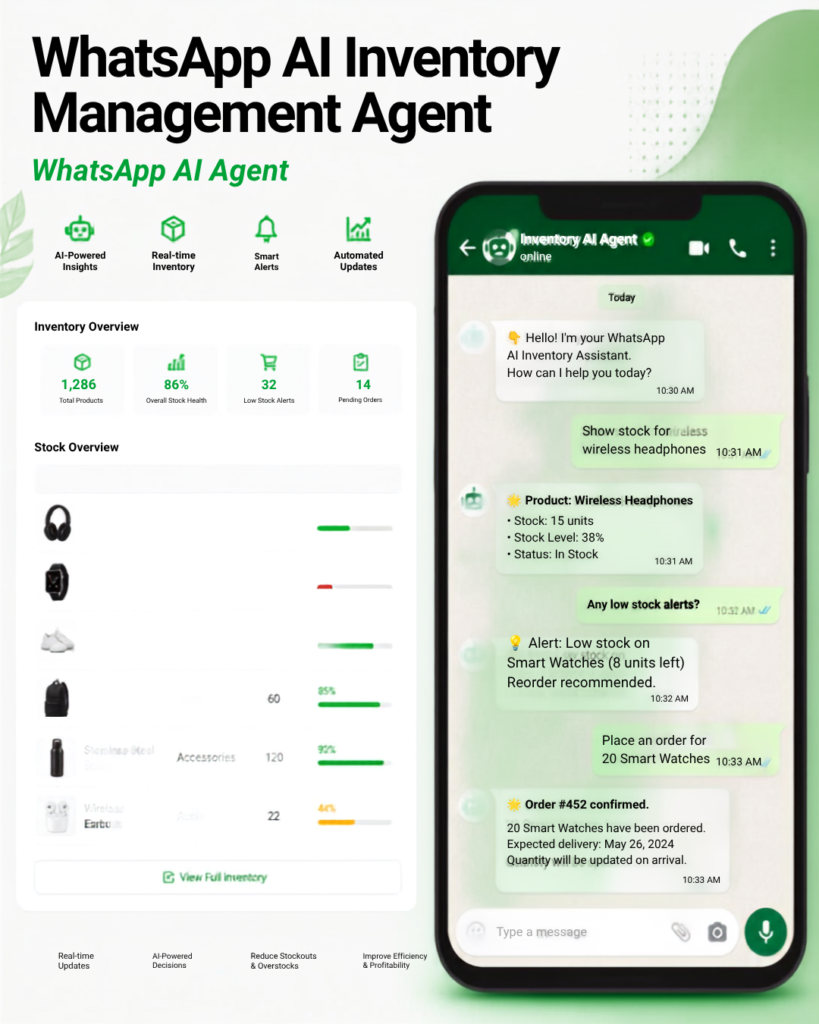
What Is a WhatsApp AI Agent Inventory Management?
A WhatsApp AI Agent Inventory Management is an AI-powered system that helps businesses manage inventory-related customer conversations through WhatsApp.
The agent can communicate with customers, understand their questions, check available inventory data when properly integrated, and provide relevant responses.
For example, a customer might send:
“Do you have the black Nike shoes in size 42?”
Instead of an employee manually checking a stock system and replying later, the AI agent can retrieve the available information and respond.
It may also help customers with questions such as:
- Is this product available?
- Which sizes are in stock?
- Do you have another color?
- When will this item be available?
- Can I order this product?
- How many units are available?
- Can you notify me when it comes back?
- Has my requested item been restocked?
The exact capabilities depend on the systems connected to the agent.
The Real Problems Businesses Face With Inventory
Inventory management is not only about counting products.
A major problem is communication.
A business may have accurate inventory data in one system, while customers are asking questions through WhatsApp. If those systems are not connected, an employee becomes the middleman.
That creates several problems.
Customers Wait for Stock Information
A customer asks:
“Is the blue jacket available in medium?”
An employee has to:
- Open the inventory system.
- Search for the product.
- Check the size.
- Return to WhatsApp.
- Write the response.
One message is not a disaster. Multiply that by dozens or hundreds of conversations, and suddenly someone has spent half the day answering questions that a properly connected system could handle automatically.
Customers Order Products That Are Not Available
This is one of the more serious problems.
If customers cannot see accurate availability, they may place orders for products that have already sold out.
The business then has to contact the customer, explain the situation, offer alternatives, and potentially process a refund.
That creates unnecessary work and a poor customer experience.
Stock Information Becomes Outdated
Inventory changes constantly.
One customer buys three units. Another employee receives a shipment. A product gets damaged. Another order is cancelled.
If the information shown to customers is not updated, the business can end up communicating inaccurate availability.
Employees Repeat the Same Answers
Businesses often receive repetitive questions:
“Do you have this?”
“What colors are available?”
“What sizes do you have?”
“When will it be back?”
“Can I order five?”
These questions may be simple, but they consume employee time.
A WhatsApp AI Agent Inventory Management can handle many of these routine conversations automatically when it has access to reliable inventory information.
How Does a WhatsApp AI Agent Inventory Management Work?
The basic workflow connects WhatsApp, the AI system, and the business’s inventory information.
A customer sends a message through WhatsApp.
The AI analyzes the message and identifies what the customer wants.
For example:
Customer: “Do you have 3 black hoodies in large?”
The system can identify:
- Product: Hoodie
- Color: Black
- Size: Large
- Quantity: 3
It can then check the available inventory data.
If three units are available, the agent can tell the customer that the requested quantity is available.
If only one is available, it can explain that only one is currently listed as available.
This simple interaction can prevent unnecessary back-and-forth communication.
Common Customer Problems the AI Agent Can Solve
The strongest reason to use inventory automation is not the technology itself. It is the problems customers experience.
Problem 1: “Is This Product Available?”
This is one of the most basic customer questions.
Customers do not want to wait several hours for an answer about whether an item is in stock.
The AI agent can provide availability information immediately when connected to current inventory data.
Problem 2: “Do You Have My Size?”
Clothing, footwear, accessories, and other products often have multiple variations.
Customers may need to know whether a specific combination is available.
For example:
“Do you have the white shirt in XL?”
A properly configured agent can check the relevant variation rather than simply responding that the product exists.
Problem 3: “Do You Have Another Color?”
Customers frequently ask for alternatives.
The AI can potentially identify available product variations and show the customer other colors, sizes, or models.
This can also create an opportunity for additional sales.
Instead of losing a customer because the requested color is unavailable, the business can offer an available alternative.
Problem 4: “When Will It Be Back in Stock?”
An out-of-stock product does not necessarily mean a lost customer.
If the business has expected restock information, the AI can communicate it.
For example:
“The blue version is currently out of stock. The next shipment is expected next week.”
If there is no confirmed restock date, the agent should not invent one. Artificial intelligence already has enough opportunities to embarrass humanity without making up delivery schedules.
Problem 5: “Can You Notify Me When It Is Available?”
A customer may want a product but find that it is currently unavailable.
A useful inventory automation workflow can collect the customer’s request and trigger a notification when the product becomes available, depending on the integrations being used.
This can help businesses recover potential sales from out-of-stock products.
Using WhatsApp AI to Reduce Stock-Related Customer Complaints
Inventory mistakes can quickly become customer service problems.
Imagine a customer orders a product and later receives a message saying:
“Sorry, we don’t actually have it.”
The problem is no longer just inventory management. Now the business has a disappointed customer.
An AI system cannot magically create inventory, but it can help prevent some communication errors by checking available information before confirming an order.
The workflow might look like this:
Customer selects product → AI checks availability → Customer confirms → Order is created → Inventory is updated
When the systems are properly integrated, this creates a more consistent process.
Can a WhatsApp AI Agent Automatically Update Inventory?
Potentially, yes, but this depends entirely on the integrations and permissions available to the system.
For example, if a business connects its WhatsApp AI agent to an e-commerce platform or inventory database, the agent may be able to retrieve current stock information.
Some systems may also allow the agent to trigger actions such as:
- Creating an order
- Reducing stock
- Updating order status
- Marking items as unavailable
- Creating restock notifications
However, businesses should carefully control what the AI is allowed to modify.
Reading inventory data is generally less risky than changing inventory records.
For important stock operations, businesses may want approval rules or system-level safeguards.
WhatsApp AI Agent Inventory Management for E-Commerce
E-commerce businesses can benefit significantly because customers often ask product-related questions before purchasing.
A customer may ask:
“Is this available?”
“Do you have 2 pieces?”
“What sizes are available?”
“Can I order this now?”
“Which model is in stock?”
If the AI can access accurate inventory information, these questions can be answered without requiring an employee to manually search for every product.
This can be especially useful for businesses receiving large numbers of WhatsApp messages from customers. Read about Lead Generation of Ai Agent.
WhatsApp AI Agent Inventory Management for Local Stores
The system is not limited to large e-commerce companies.
Local businesses can also use WhatsApp as a product inquiry and ordering channel.
For example, a local electronics store may receive messages such as:
“Do you have an iPhone charger?”
“Is the 20W adapter available?”
“Do you have this model in black?”
A customer could potentially check availability through WhatsApp before visiting the store.
This saves the customer a wasted trip and saves the employee from answering the same question repeatedly.
WhatsApp AI Agent Inventory Management for Restaurants
Restaurants have a different inventory problem.
Customers may ask:
“Is the chicken burger available?”
“Do you still have this meal?”
“Is this item available today?”
If the restaurant’s system supports relevant inventory or menu availability information, AI automation can help communicate changes to customers.
It can also prevent customers from ordering unavailable menu items through supported ordering workflows.
Benefits of a WhatsApp AI Agent Inventory Management
Faster Answers
Customers can receive responses to routine inventory questions without waiting for an employee.
Fewer Manual Checks
Employees do not need to repeatedly search inventory systems for simple availability questions.
Better Customer Experience
Customers receive clearer information before placing an order.
Fewer Availability Mistakes
Connecting customer communication with inventory data can reduce situations where customers are promised unavailable products.
More Sales Opportunities
When one product is unavailable, the AI can potentially recommend another available product or variation.
Better Employee Productivity
Employees can spend more time handling complex orders and customer issues instead of repeatedly answering basic stock questions.
What Should a Good AI Inventory Agent Know?
An inventory agent should have access to accurate and relevant information.
Depending on the business, this may include:
- Product names
- Product IDs
- Available quantities
- Sizes
- Colors
- Variations
- Prices
- Locations
- Warehouse availability
- Restock information
- Product descriptions
- Ordering rules
The system should also understand the difference between available, reserved, out of stock, and discontinued products when those statuses exist in the business system.
This matters because “we have 10 units in the database” does not necessarily mean “10 units are available for immediate purchase.”
When Should the AI Transfer the Customer to a Human?
Automation should have limits.
Some inventory situations require human involvement.
Examples include:
- Conflicting stock information
- Large wholesale orders
- Special pricing requests
- Damaged inventory
- Supplier problems
- Refund disputes
- Unusual product requests
- Inventory discrepancies
- Customer complaints
The AI should recognize these situations and transfer the conversation instead of confidently producing nonsense.
A good AI agent knows when it does not have enough information.
That is a surprisingly important feature.
How to Set Up a WhatsApp AI Agent Inventory Management?
A basic implementation can follow these steps.
Step 1: Connect WhatsApp
Set up the appropriate WhatsApp business communication infrastructure for automated conversations.
Step 2: Connect the Inventory System
Connect the AI agent to the system containing the business’s inventory information.
This could be an e-commerce platform, inventory management system, database, or another supported source.
Step 3: Define Customer Questions
Identify the questions customers ask most frequently.
Start with common requests such as:
- Product availability
- Size availability
- Color availability
- Quantity
- Restock dates
- Product alternatives
Step 4: Define AI Permissions
Decide what the AI can read and what it can change.
For example:
Read inventory: Allowed
Recommend alternatives: Allowed
Create order: Allowed
Change inventory manually: Restricted
Approve unusual refunds: Human required
These rules help reduce costly mistakes.
Step 5: Add Human Handoff
Create clear escalation rules for situations the AI cannot safely handle.
Step 6: Test With Realistic Conversations
Test the agent using common customer questions and difficult situations.
Do not only test:
“Is product X available?”
Also test:
“I need 50 units.”
“Your website says available but WhatsApp says out of stock.”
“I ordered yesterday and now it says unavailable.”
“Can you reserve this for me?”
Real customers have a remarkable talent for asking the question nobody thought to test.
Frequently Asked Questions
What is a WhatsApp AI Agent Inventory Management?
It is an AI-powered system that helps businesses handle inventory-related customer conversations through WhatsApp. It can answer availability questions, identify product variations, provide stock information, and support ordering workflows when connected to business inventory systems.
Can it tell customers whether a product is in stock?
Yes, provided the agent has access to accurate inventory data. It can check the relevant product or variation and communicate the available information.
Can it notify customers when products are restocked?
This can be supported when the business has a suitable restock notification workflow. Customers can submit their request, and the system can notify them when the product becomes available.
Can it manage multiple product variations?
Yes. A properly configured system can work with variations such as size, color, model, quantity, or other product attributes.
Can small businesses use it?
Yes. A small business may benefit if it receives frequent WhatsApp questions about products and availability. The value depends on message volume and the quality of the inventory system.
Does an AI inventory agent replace employees?
No. It is better used for repetitive tasks and routine questions. Employees should remain responsible for complex cases, exceptions, disputes, and decisions requiring judgment.
Final Thoughts
Inventory problems often become customer communication problems.
A product may be physically available but the customer cannot get a quick answer. A product may be sold out while the business continues accepting inquiries. A customer may request a specific size or color and wait hours for someone to check it.
A WhatsApp AI Agent Inventory Managementcan connect these customer conversations with inventory information and automate many repetitive requests.
The result can be faster answers, fewer unnecessary manual checks, better communication, and a smoother ordering experience.
For businesses already using WhatsApp to communicate with customers, inventory automation can turn the platform from a simple messaging channel into a practical part of the sales and order management workflow.
The important part is implementation. The AI should use reliable inventory data, follow clearly defined rules, avoid inventing stock information, and transfer complicated cases to human staff.
That is how automation becomes useful rather than just another chatbot sitting in the corner of the internet asking customers how it can help.