Managing customer orders through WhatsApp can become difficult as a business grows. A few daily orders may be easy to handle manually, but hundreds of customer messages can quickly create confusion. Customers may ask whether an order was received, request delivery updates, change product quantities, cancel orders, or simply ask when their package will arrive. Someone then has to read, understand, and respond to every message. Humanity has somehow built businesses around copying order numbers between chat windows, so automation is overdue.
A WhatsApp AI Order Management Agent can help businesses automate many of these repetitive tasks. Instead of requiring an employee to answer every routine question, an AI agent can communicate with customers through WhatsApp, collect order information, provide updates, answer common questions, and route more complicated requests to a human team member.
For online stores, restaurants, service businesses, and other companies that already communicate with customers through WhatsApp, this type of automation can make order management faster and more organized.
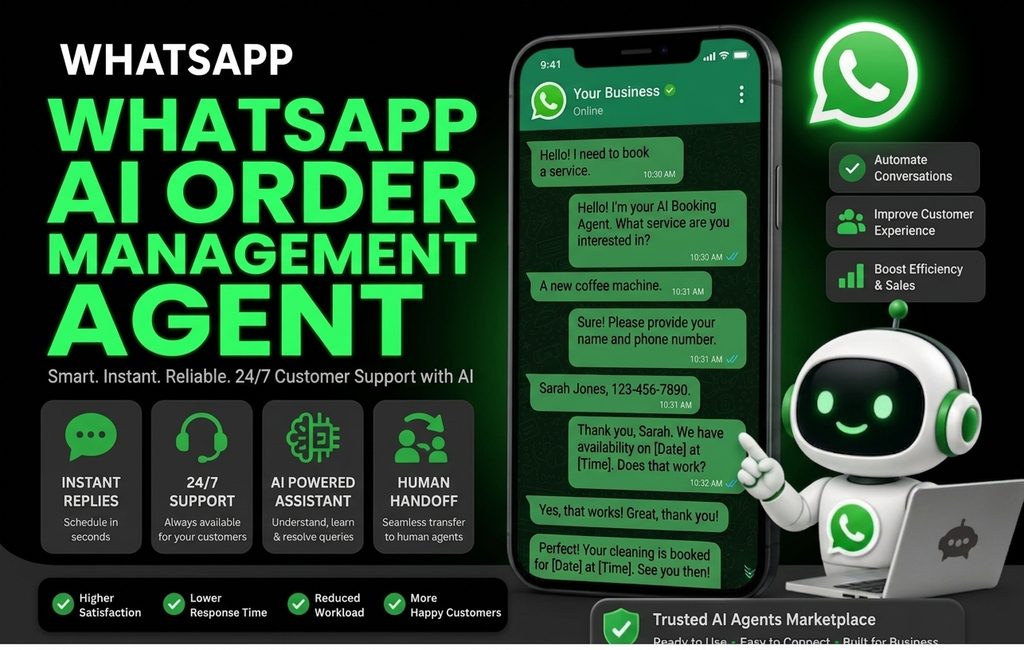
What Is a WhatsApp AI Order Management Agent?
A WhatsApp AI Order Management Agent is an AI-powered system that helps businesses manage customer orders and order-related conversations through WhatsApp.
The agent can understand customer messages, identify what the customer needs, retrieve relevant information from connected business systems, and provide an appropriate response.
For example, a customer could send:
“Where is my order #4582?”
Instead of an employee manually checking the order system, the AI agent can identify the order number, check its current status, and respond with the available information.
Depending on how the system is configured, the agent may also help customers:
- Place new orders
- Confirm order details
- Check order status
- Request delivery information
- Modify an order
- Cancel an order
- Ask about products
- Confirm prices and quantities
- Receive order notifications
- Contact a human representative when necessary
The goal is not simply to create a chatbot that says, “How may I help you?” and then becomes mysteriously useless. A properly configured AI agent should be connected to the business’s actual workflows and information.
How Does a WhatsApp AI Order Management Agent Work?
The basic process is relatively straightforward.
A customer sends a message to the business’s WhatsApp account. The AI system receives the message and analyzes its intent.
For example, the customer might write:
“Can I add two more items to my order?”
The system can recognize that the customer is asking to modify an existing order. It can then request the necessary information, such as the order number and products, before checking whether the modification is possible.
A typical workflow looks like this:
Customer message → AI understands request → Order information is checked → AI performs or requests the appropriate action → Customer receives a response.
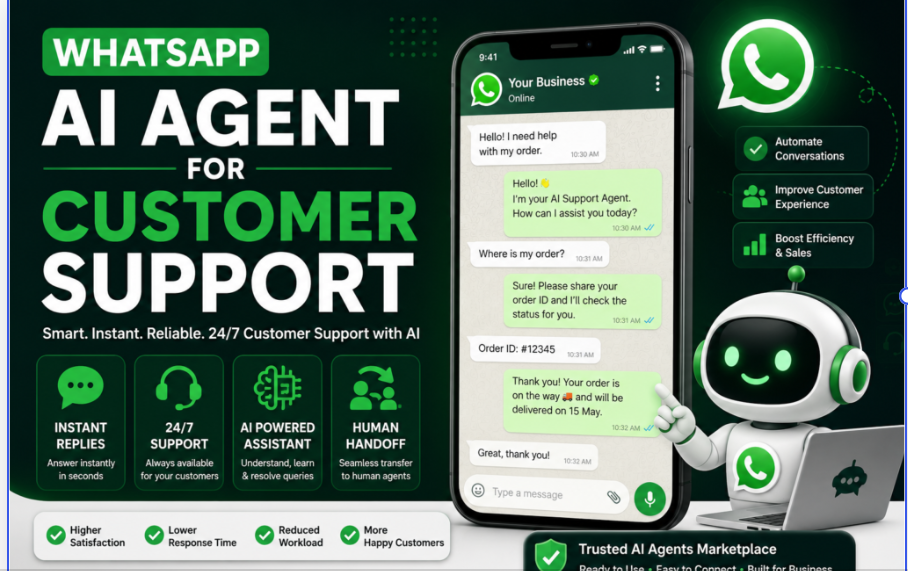
The AI agent can be connected with an e-commerce platform, CRM, inventory system, order database, shipping system, or other business software depending on the automation setup.
This allows WhatsApp to become more than a communication channel. It can become an interface through which customers interact with the company’s order system.
What Can a WhatsApp AI Order Management Agent Automate?
One of the biggest advantages is the ability to automate repetitive conversations.
1. New Order Collection
Customers can send product names, quantities, delivery details, and other required information through WhatsApp.
The AI agent can guide the customer through the ordering process and make sure important information is collected.
For example:
- Product: Wireless headphones
- Quantity: 2
- Delivery location: Lahore
- Customer name: Ahmed
- Contact information: Provided through WhatsApp
The system can then summarize the order before confirmation.
2. Order Confirmation
After a customer places an order, the AI agent can provide a confirmation message containing relevant information.
This may include:
- Order number
- Products ordered
- Quantity
- Total amount
- Delivery address
- Estimated delivery information
This reduces the number of customers contacting support simply to confirm whether their order was successfully placed.
3. Order Status Updates
“Where is my order?” is one of the most predictable questions in e-commerce.
A WhatsApp AI Order Management Agent can handle these requests when connected to an order or shipping system. Read More About Whatsapp AI Sales Agent work.
Customers can provide their order number, and the system can return the latest available status, such as:
- Order received
- Processing
- Packed
- Shipped
- Out for delivery
- Delivered
If tracking information is available, the agent can also provide the relevant tracking details.
4. Order Changes
Customers sometimes change their minds. Naturally, usually after the order has already entered processing.
An AI agent can collect requests such as:
“I want to change the color.”
“Please increase the quantity to three.”
“Can I change my delivery address?”
The agent can determine whether the requested change is supported by the business workflow. If it cannot safely make the change automatically, it can forward the request to a human employee.
5. Order Cancellation Requests
The agent can also handle cancellation requests according to the company’s rules.
For example, it could ask for the order number and check whether the order is still eligible for cancellation.
If cancellation is permitted, the system can initiate the appropriate workflow. If the order has already shipped, the request can be transferred to customer support.
This approach is better than allowing an AI system to blindly promise cancellations that the business cannot actually process.
Why Businesses Use AI for WhatsApp Order Management?
The main reason is simple: repetitive communication consumes time.
Employees can spend a large part of their working day answering questions that have predictable answers.
Customers may repeatedly ask:
- “Has my order been confirmed?”
- “Where is my package?”
- “What is my order number?”
- “Can I change my address?”
- “Can I cancel my order?”
- “When will it arrive?”
- “Do you have this product?”
Automating routine conversations allows employees to focus on cases requiring judgment, problem-solving, or personal assistance. Read More in Detail of Pre built Whatsapp ai agent and Business.
A WhatsApp AI Order Management Agent can also provide faster responses because customers do not necessarily have to wait for an employee to become available.
Benefits for E-commerce Businesses
Faster Customer Responses
Customers generally prefer immediate answers, especially when asking about an existing purchase.
An automated agent can respond to supported requests without requiring a support employee to manually open the order system.
Reduced Repetitive Work
Support teams can spend less time answering the same basic order questions repeatedly.
This does not mean eliminating human support. It means using humans where human judgment is actually useful.
Better Order Communication
Customers can receive structured information about their orders instead of sending multiple messages back and forth.
Clear communication can reduce misunderstandings and unnecessary support requests.
24/7 Availability
A WhatsApp-based AI agent can remain available outside normal business hours, depending on the company’s infrastructure and configuration.
A customer placing an order late at night does not necessarily need to wait until morning just to receive basic information.
Scalable Customer Support
As order volume increases, businesses may need additional employees to manage customer conversations.
Automation can help absorb some of that additional workload without requiring every routine conversation to be handled manually. AI agent For customer support.
WhatsApp AI Order Management Agent vs. Manual Order Management
Manual order management can work well for small businesses with a limited number of customers.
However, as order volume increases, several problems can appear.
| Manual Management | AI-Assisted Management |
|---|---|
| Employees answer repetitive questions | AI handles supported routine questions |
| Responses depend on staff availability | Automated responses can operate continuously |
| Orders may require manual data entry | Information can be collected systematically |
| Customers may wait for updates | Routine updates can be delivered faster |
| Difficult to scale manually | Automation can support higher message volume |
| Employees spend time on basic requests | Staff can focus on complex issues |
AI is not automatically better simply because the letters A and I have been attached to it. The value comes from connecting the system to useful business processes and giving it reliable information.
Who Should Use a WhatsApp AI Order Management Agent?
This type of automation can be useful for businesses that receive significant customer communication through WhatsApp.
Potential users include:
- E-commerce stores
- Clothing businesses
- Electronics stores
- Grocery businesses
- Restaurants
- Pharmacies where legally appropriate
- Beauty product stores
- Home businesses
- Local retailers
- Subscription businesses
- Delivery-based businesses
It can be especially useful for businesses where customers repeatedly ask about orders, products, delivery, and availability.
How to Set Up a WhatsApp AI Order Management Agent
The exact setup depends on the business and the systems it already uses.
A typical implementation involves several components.
Step 1: Connect WhatsApp
The business needs an appropriate WhatsApp business communication setup that allows automated messaging.
Step 2: Connect Business Data
The AI agent needs access to the information it is expected to use.
This could include:
- Product catalog
- Prices
- Inventory
- Orders
- Customer information
- Shipping status
- Delivery information
- Company policies
Step 3: Define Workflows
The business should decide which tasks the AI can perform automatically.
For example:
Order status → automated
Product information → automated
Order cancellation → automated only when conditions are met
Refund dispute → human support
This prevents the AI from making decisions outside its authority.
Step 4: Create Escalation Rules
Not every problem should be handled by automation.
The system should know when to transfer a conversation to a human representative.
Examples include:
- Payment disputes
- Complicated refunds
- Angry customers
- Technical problems
- Orders with unusual circumstances
- Requests outside the agent’s capabilities
Step 5: Test Before Launch
Businesses should test different customer conversations before allowing the system to handle real orders.
Testing should include successful orders, incomplete information, cancellations, incorrect order numbers, unavailable products, and unusual customer requests.
Common Questions Customers Can Ask
A well-designed AI order agent can handle many straightforward customer questions.
Examples include:
“What is the status of my order?”
The agent can retrieve the latest available status.
“Can I change my delivery address?”
The agent can check the business’s rules and determine whether an address change is possible.
“I want to cancel my order.”
The agent can collect the order number and check whether cancellation is allowed.
“Has my order shipped?”
The agent can check the relevant order or shipping status.
“Can I add another product?”
The agent can determine whether the order can still be modified.
The important point is that the agent should not invent information. If the required data is unavailable, it should clearly tell the customer that the request needs human assistance.
What Makes a Good AI Order Management Agent?
A useful system should be more than an automated message generator.
Important capabilities include:
- Accurate order information
- Clear conversation flows
- Reliable product information
- Human handoff
- Order tracking integration
- Customer identification
- Error handling
- Business-specific rules
- Conversation history
- Secure handling of customer information
Businesses should also regularly review conversations to identify mistakes and improve the automation.
The best automation does not try to pretend that humans are unnecessary. It handles predictable tasks efficiently and sends complicated situations to people.
Frequently Asked Questions
What is a WhatsApp AI Order Management Agent?
A WhatsApp AI Order Management Agent is an AI-powered automation system that helps businesses manage orders and customer conversations through WhatsApp. It can assist with order collection, confirmations, status updates, changes, cancellations, and routine customer questions.
Can it track customer orders?
Yes, when it is connected to an order or shipping system containing the necessary information. The agent can retrieve available order status and communicate it to customers through WhatsApp.
Can it automatically take orders?
Yes. Depending on the setup, customers can provide product, quantity, delivery, and other required information through WhatsApp. The system can then process the information according to the business’s workflow.
Can customers cancel orders through the AI agent?
They can request cancellation, but whether the AI can complete the cancellation automatically depends on the company’s rules and system integration. Some orders may require human approval.
Can the AI transfer customers to a human?
Yes. Human handoff is an important part of a reliable automation system. Complex, sensitive, or unsupported requests should be transferred to a human representative.
Is this useful for small businesses?
It can be. Small businesses that receive many repetitive WhatsApp messages may use automation to reduce manual customer support work and respond more consistently.
Final Thoughts
WhatsApp has become an important communication channel for many businesses, but manually managing every order-related conversation can become increasingly difficult as customer volume grows.
A WhatsApp AI Order Management Agent can automate repetitive tasks such as collecting orders, confirming purchases, checking order status, handling eligible changes, and answering common customer questions.
The biggest advantage is not simply that the system uses artificial intelligence. The real benefit comes from connecting customer conversations with the business’s actual order workflows.
When properly configured, AI can handle routine requests while human employees concentrate on complex problems that require judgment and personal assistance.
For businesses looking to reduce repetitive WhatsApp conversations and create a more efficient ordering process, an AI-powered order management agent can be a practical addition to their automation strategy.
Find Out Instagram AI Agents: 1- AI Booking Agent For Instagram Booking DM , Instagram AI Agent Lead Generation .
Ready to automate your WhatsApp order workflow? Explore pre-built AI agents designed to handle customer conversations, order management, sales, support, and other repetitive business tasks.